 Cloud 9· healthcare

the room you painted yourself
Every practice has two waiting rooms — and only one of them has chairs.
The first one you know by heart: the light, the magazines, the front desk that greets people by name. The second one is invisible. It’s the room made of hold music — the weekend flare-up on line one, the referral on line three — and at a busy practice it’s standing-room only by nine on Monday morning. Nobody complains about the second waiting room. They just leave it, tap the next practice on Google, and never tell you they were here. Cloud 9 closes that room: one team that answers every call in seconds around the clock, books straight onto your schedule, routes every clinical question to your team per your protocol — and runs the marketing that decides who gets called first.
$1,497/mo, flat — the desk and the marketing, one team, nothing itemized. First month today · no setup fee · cancel anytime.
the room made of hold music
It’s Monday, 8:47 a.m. The second room is filling.
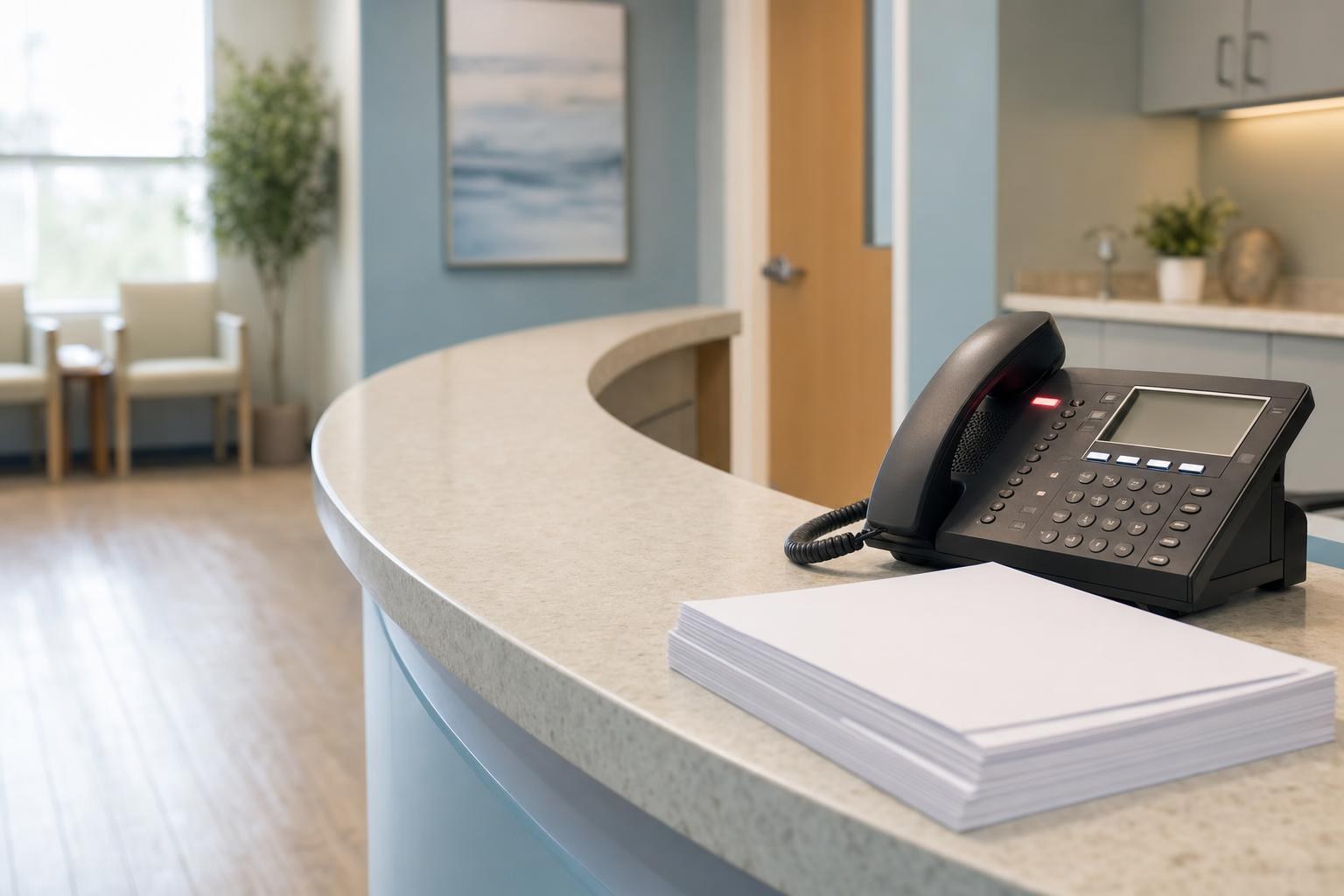
All four lines are lit. Your second receptionist gave notice on Friday and the temp agency hasn’t called back. Line one is a weekend flare-up, four minutes deep into the hold queue. Line two is a pharmacy. Line three — you don’t know it yet — is a new patient with good insurance, referred from two towns over. She’ll let it ring seven times, hang up, tap the practice with three hundred forty reviews, and be booked there by 9:02. You never hear that door close, because the second waiting room doesn’t have a door. It has a red light.
And the clock on that room is merciless: according to Dialog Health’s 2025 aggregate, healthcare callers hold an average of more than four minutes — and roughly 60% of callers hang up after about a minute on hold.
Cloud 9’s desk empties that room the other way. Every call answered in seconds — Monday at 8:47, Saturday at noon, any night at 2 a.m. — in English or Spanish, with the appointment booked before goodbye. The hold queue simply never forms.
the staffing arithmetic
The phones didn’t break because of you. They broke because the desk keeps emptying.
MGMA’s 2025 Stat polling puts the staffing shortage’s sharpest edge exactly where you stand: front-desk staff and medical assistants are the roles practices report hardest to fill and quickest to lose — and the most-cited tactic for keeping front-desk staff is simply paying more (a third of groups said “raise the wage” — MGMA Stat, May 2025). So the honest math of Monday morning is this: the phone didn’t go unanswered because anyone stopped caring. It went unanswered because the person who used to answer it is gone, and her replacement hasn’t been hired yet.
Meanwhile, each call that walks isn’t a call — it’s a relationship. According to PatientGain, an average primary-care patient relationship is worth about $3,000 over its life. One recovered new patient a month covers this entire page twice over — arithmetic on attributed figures, not a promise.
If you live on referrals, it’s worse.
For specialty and PT practices the second waiting room has a second name: referral leakage. According to ReferralMD, somewhere between a quarter and half of referrals never complete. Some of that is insurance. Some of it is simply the referred patient calling once, holding, and quietly never becoming your patient. An unanswered phone is referral leakage — the desk answers it in seconds, books the evaluation while the referral is warm, and the referring office learns you’re the practice that picks up.
Follow-through → Recall & the quiet ones → Balances by text →
the room’s front door
The second waiting room has a front door. It’s the search results.
Before anyone holds on your line, they chose to dial it — and that choice happens on a screen where the hospital-owned group up the road shows three hundred forty reviews to your twelve. According to rater8’s 2025 survey, 84% of patients read online reviews before choosing a provider. This is the part of the leak you can’t hear from the desk: the rankings, the listings, the reviews nobody ever asked your patients to write.
Cloud 9 runs it as the same job, because it is the same job — the ringing you can hear and the rankings you can’t see drain the same schedule. One team keeps your practice found, chosen, answered, booked, and reviewed, and it writes every review reply so it never confirms that any reviewer is a patient. One machine.
Reviews, asked for → Local SEO → The site → Listings → Social → Ads at cost → Steady touches →
the line the desk never crosses
What we never touch.
A desk that answers for a practice has to know exactly where its job ends. This one is built around that line — no badges, just behavior you can test on the very first call:
A clinical question→never answered at the desk — not once, not “just this time.” Taken down word for word and routed to your clinical team, per your written protocol.
A refill request→no yes, no no, no “should be ready by Friday.” The pharmacy, the medication as stated, the callback number — moved to your team exactly the way your protocol routes it.
A results call→never read, never hinted at, never guessed about. The desk books the follow-up your protocol calls for and puts the message where you want it.
Anything urgent-sounding→your escalation list, followed to the letter — who gets reached first, what the caller is told meanwhile, including “hang up and dial 911” whenever your protocol says so.
Medical advice→none. Ever. In any language. The desk takes messages, books appointments, and routes clinical calls to your team — that is the whole design.
A review about care→answered warmly and specifically about service — and written so it never confirms the reviewer is, or ever was, a patient.
Your protocol is written down once, together, before the first call — and the desk never improvises past it.
The fastest way to evaluate a desk is to talk to it.
Text or call right now — outside business hours is the best test there is. You’ll hear exactly what your patients would hear.
the whole bill
Healthcare bills by the thousand line items. This bill has one.
Sold separately, the pieces rent for real money: medical answering runs $100–$1,000+ a month (according to Ambs, 2025), and healthcare marketing retainers run $1,500–$5,000+ a month (according to WebFX) — two vendors, two bills, each blaming the other for the empty schedule.
Billed annually it’s $11,976 — about $998 a month, four months free, custom site build included.
FIRST MONTH TODAY · NO SETUP FEE · MONTH-TO-MONTH · CANCEL ANYTIME · AD BUDGET AT COST
And no surprise billing, ever: the line is written once, and no adjustment ever gets filed against it — what it says above is what your statement will always say.
Every job inside the one line, itemized the way the rest of healthcare loves to be: the desk · bilingual · scheduling & confirmations · text-back · follow-through · balances by text · recall & win-back · steady touches · reviews · local SEO · the site · listings · social · ads at cost — or read the whole machine and the one price.
If you ever want to know who is responsible for all of this, it’s one person with a name and a number — Willie, San Antonio. Ask for him and you get him.
the flowsheet
Questions, charted the way you’d chart anything else.
A patient calls with a clinical question. What exactly happens?
The desk never answers it — not even the easy-sounding ones, not even when the caller pushes. It tells the patient, warmly, that a clinical question belongs with the clinical team, takes the message down word for word, and routes it exactly where your written protocol says it goes — a message to your MA pool, a task for the on-call provider, a call-back slot on the schedule. You define the routing once; the desk follows it every time, at noon and at midnight.
What about refill requests and test results?
Handled the same disciplined way: never answered, always moved. A refill request is captured with the pharmacy, the medication as the caller states it, and the callback number, then routed to your team per your protocol. A results call is never read from, hinted at, or guessed about — the desk books the follow-up your protocol calls for and gets the message to the right person. The patient hears a calm voice and a clear next step; your clinical team keeps every clinical decision.
Who answers at two in the morning?
The same desk, sounding exactly the way it does at two in the afternoon. After-hours callers reach a live answer in seconds, in English or Spanish. Routine matters become messages and booked appointments waiting for your morning staff. Anything that matches your escalation list is moved per your instructions — who gets reached first, and what the caller is told in the meantime, including telling the caller to hang up and dial 911 whenever your protocol says so.
Can it actually do anything about no-shows and recall?
Yes — because both are phone-coverage problems wearing different clothes. Tomorrow’s schedule gets confirmed by call and text; the patient who cancels frees a slot the desk offers to your waitlist; the patient overdue for recall gets a friendly nudge and a booking link. According to Curogram, a no-show costs a practice roughly $200 — and MGMA’s January 2025 Stat poll found 42% of medical groups now charging no-show fees just to blunt it. Filled slots beat fees.
We’re a specialty practice. Referrals are our whole front door.
Then the second waiting room is costing you the most. According to ReferralMD, somewhere between a quarter and half of referrals never complete — and part of that gap is nothing more than a referred patient calling once, holding, and giving up. The desk answers referral calls in seconds, books the evaluation while the referral is still warm, takes coordination messages from referring offices, and routes anything clinical to your team. The referring doctor hears their patient was seen quickly — and that reputation is how the next referral gets sent.
How is this different from a medical answering service?
An answering service answers the phone. It doesn’t make the phone ring. Cloud 9 does the answering — messages taken, appointments booked onto your schedule, clinical calls routed to your team per your protocol, around the clock, in two languages — and it also runs the machine that fills the line in the first place: the site, the local search, the listings, the reviews, the follow-up, the recall. One team, one number to call when you want anything changed, and no gap in the middle for a new patient to fall through.
What does setup ask of us?
Your part is one meeting and a yes. We sit down with you or your practice manager and write the protocol with you — the schedule rules, the escalation list, exactly where clinical questions, refills, and results go, and how you want your practice’s name said out loud — and from then on the tuning is ours: weekly, against what your calls really sound like. The desk is typically answering within about four days, and your own number carries the texting as soon as carrier registration clears.
What does it cost?
One line item: $1,497 a month, flat — the desk and the marketing together, all fourteen jobs. Prefer annual billing? $11,976 for the year — about $998 a month, four months free, plus a custom site build. The first month is billed today, there’s no setup fee, the agreement is month-to-month, you can cancel anytime, and ad budget passes through at cost. And there’s no surprise billing — the line is written once and never adjusted.
LINE TWO · NO ONE IS HOLDING
The second waiting room doesn’t have to exist.
Close it, and everything in it walks back into the room with the chairs: the flare-up gets seen, the referral becomes a patient, the review gets written, the schedule stops leaking. Every call answered in seconds, every clinical question routed to your team per your protocol, every search a little more yours — one machine, $1,497 a month, flat.
Not ready to talk yet? Take the free 60-second audit for your practice — see where you stand first.
SE HABLA ESPAÑOL · SUS PACIENTES PUEDEN LLAMAR EN SU IDIOMA, A CUALQUIER HORA · SAN ANTONIO, TX
Cloud 9 around the practice: chiropractors · dental · hospice · all industries · pricing · the machine