- The storm surge is won or lost in the first 48 hours — and roughly 27% of callers who reach silence never call back (Invoca call analytics).
- Bids die of silence, not price: 93% of leads that convert are reached by the sixth attempt (Velocify, 3.5M leads), so the follow-up cadence matters as much as the answer.
- Storm chasers flood in after every big hail event — which makes answering fast and proving you’re local the two things that actually separate you.
Storm leads are decided in the first 48 hours after hail: the roofer who answers in seconds, inspects first, and follows every bid until it signs takes the season. That means every call answered 24/7 — surge included — instant text-back on any missed call, and follow-up that runs to day thirteen without anyone remembering it.
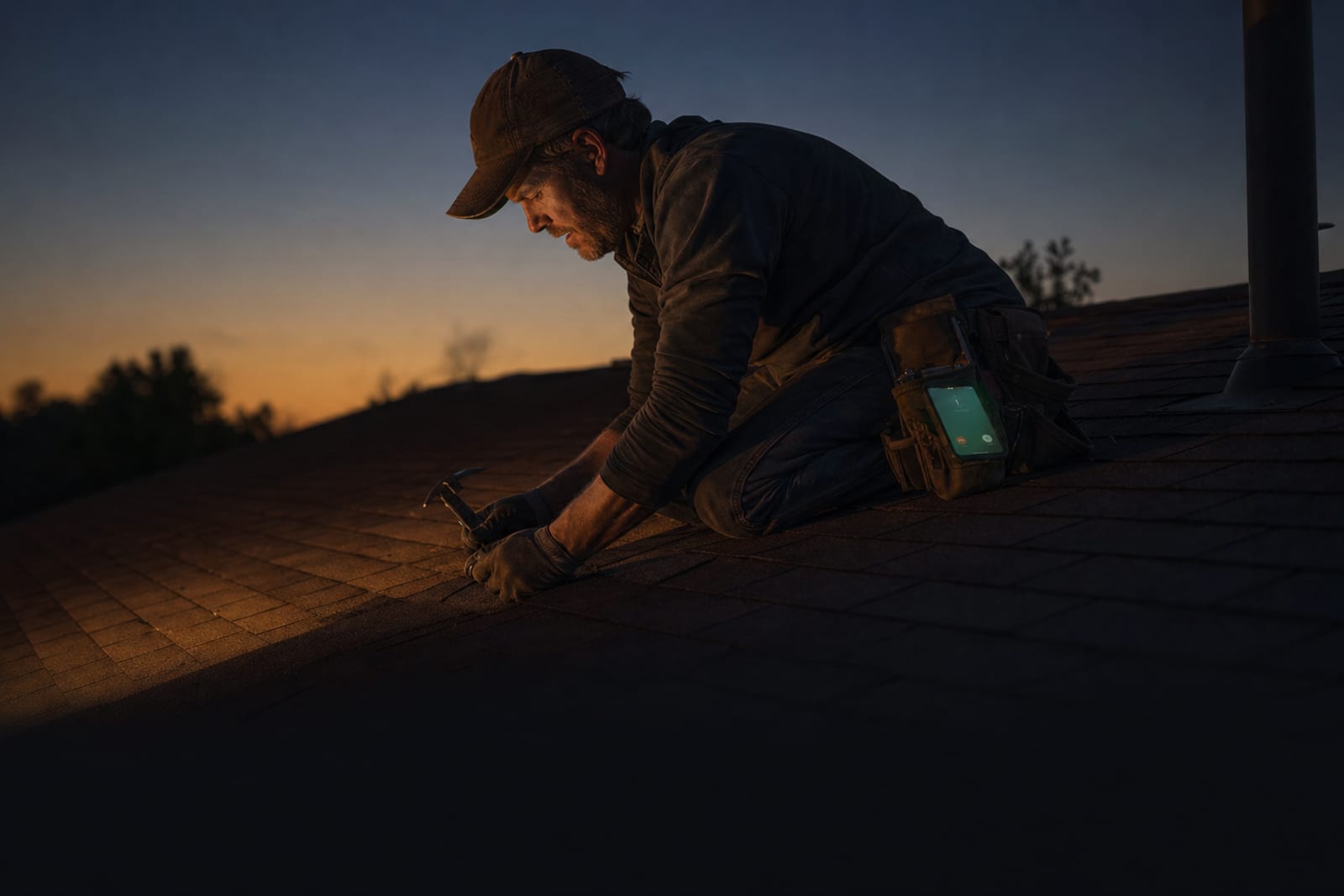
Hail doesn’t schedule around your office. The cell crosses town at dinnertime, and by the time the sun is back out, every roof under it has become a phone call — most placed within the next two days, almost all of them to more than one roofer. Never missing a roofing lead after a storm is not about heroics during the surge. It is a playbook you build before the season: a phone answered in seconds while your crews are on roofs, a follow-up cadence that walks every bid to a yes or a plain no, and enough local proof that the homeowner picks your truck over the out-of-town one. Here is the whole playbook.
The 48 hours that decide storm season
The morning after a hail event, every roofer in three counties is driving the same neighborhoods. Adjusters are booking up. Homeowners are standing in driveways looking at dented gutters and shredded shingles, doing what careful people do with the biggest surface of their house: collecting bids. The three-estimate kitchen table is real. Nobody signs the first company that shows up — they line up a few, compare, and sleep on it.
Which means the surge is not one race, it is two. The first is getting into the stack of bids at all, and that one is decided by whether anyone answers when the homeowner calls. The second is winning the stack once you’re in it, decided in the two weeks after your estimate hits the table. Most roofing companies lose the season in the first race without ever knowing it happened, because a missed call doesn’t leave a mark — the homeowner just moves to the next name. And the timing is cruel: a hail week can bring more calls in three days than a normal month delivers, at exactly the moment your crews are stretched thinnest. Your capacity to answer is lowest when the calls are worth the most.
The storm-chaser problem (and why it helps you)
Every serious hail event pulls in the out-of-town operators. Trucks with fresh magnetic door signs, crews nobody local has heard of, door knocks that start with “we’re doing your neighbor’s roof.” Some do fine work and leave. Some do fast work and leave faster — and the homeowner is left holding a workmanship warranty from a company two states away.
Homeowners know this, and it is why so many are wary of every roofer for the first week after a storm. That wariness is your opening, because the two things a chaser cannot fake are the two things a local shop can build in advance.
- A phone that answers like a real company. A chaser working a hundred doors doesn’t run a front desk. When the homeowner calls at 8 p.m. and reaches a real answer in seconds, that alone separates you from the truck that only exists on the porch.
- A local record that checks out. She will look you up before signing — the reviews, the years in the same town, the jobs on nearby streets. A chaser has no record in your market. You do, if you’ve been building it.
Honestly framed, the chaser problem is good news for the prepared local shop: it turns answering and legitimacy into the deciding factors, and you control both.
Step 1: Answer in seconds while your crews are on roofs
Here is the number that should shape your storm plan: roughly 27% of callers give up and never call back if their first call goes unanswered (Invoca call analytics). In a normal month that is a slow leak. In a hail week, when the whole block is calling in the same hour, it is a torrent — and voicemail does not catch it, because a homeowner with three more roofing numbers in her hand has no reason to leave a message.
The fix has two layers. The first is a front desk with no busy signal — every call answered in seconds, at noon and at 10 p.m., in English or Spanish, with the storm date, address, photos, and insurance situation captured and an inspection booked onto your real calendar. Not a message pad; a booking. The difference between “someone will call you back” and “we’ll be on your roof Thursday at 8” is usually the difference between being in the bid stack and not.
The second layer is the safety net: missed-call text-back, so the rare call that slips through gets a text within seconds — “Sorry we missed you, are you calling about storm damage? We can have an inspector out this week.” It lands while she is still holding the phone, before she dials the next name, and turns a silent loss into an open conversation.
One honest boundary: answering fast does not mean quoting fast. Nobody should price a roof over the phone — pitch, decking, layers, and what the hail actually did are ladder questions. The desk catches the lead, gathers the file, and books the inspection. The number stays yours.
Step 2: Follow every bid to day thirteen
Getting into the bid stack is half the game. The other half is the two quiet weeks that follow, where most roofing revenue actually dies — not to a lower price, but to silence. The estimate sits on the kitchen table next to two others. The homeowner asks one small question into somebody’s voicemail on day five and hears nothing. She talks to her carrier, compares numbers, stalls, and eventually signs with whichever company still seemed to be paying attention when she finally decided.
The data on this is blunt: 93% of leads that convert are reached by the sixth attempt (Velocify, 3.5M leads). Six attempts. A roofer running a crew on a hot deck doesn’t have six follow-ups in his pocket for every open bid — which is why the follow-up has to run on its own. A respectful cadence looks like this:
- Same hour: a recap text with the estimate and damage photos attached — something concrete she can forward to her carrier.
- Days 2–5: the small stuff handled fast — her 9 p.m. question answered in seconds instead of Monday, the extra close-ups sent without being chased.
- Days 8–11: the payment and timing conversation in words you approved, then a quiet check-in while she compares numbers. Present, never pushy.
- Day 13: the yes — with the deposit link already sitting in the same thread — or a plain no, which is also a win, because a dead bid you know about stops costing you attention.
That is the cadence a done-for-you follow-up system runs on every open bid at once, without you climbing down a ladder to do it. It never changes your number and never pressures anyone. It just refuses to let a live bid die of neglect.
Step 3: Build the local proof that beats the chaser
Before the homeowner signs anything, she checks you out — usually from the driveway, on her phone, sometimes while your estimator is still pulling away. 98% of people read reviews for local businesses, and 88% say they would use a business that replies to its reviews, versus 47% for one that ignores them (BrightLocal, 2024). That driveway search is where the local shop beats the storm chaser — if there is something to find.
What she is looking for is proof that you were here before the storm and will be here after it: reviews from streets she recognizes, answered in a real person’s voice — including the imperfect ones, handled calmly, because how a company answers a complaint says more than ten five-star raves — photos of finished roofs in her own town, and a profile whose hours, address, and phone number all agree.
None of that can be assembled the week of the storm, which is the point. The chaser arriving Tuesday cannot manufacture two years of local reviews. The way you get them is unglamorous: ask after every single job, all year, and answer every review that comes in. The review earned on a quiet reroof in February is what wins the hail bid in May — the slowest weapon in this playbook, and the one nobody can copy on short notice.
Step 4: Set it up before storm season, not during
Everything above shares one property: it has to exist before the sky opens. The week of the storm you will have no time to build anything — you will be on roofs, which is where you belong. So the honest checklist is a pre-season checklist:
- The answering layer, wired to your real calendar and your rules for what counts as an emergency, tested on a quiet Tuesday — not configured in a panic on the loudest Thursday of the year.
- Missed-call text-back, live on your main line, so the safety net is already under you.
- The follow-up cadence, with your recap wording, payment language, and day-thirteen rhythm approved in advance.
- The review engine, running after every job for months before it matters — plus a Google profile and website that hold up to the driveway search.
For what it’s worth, this is exactly the machine Cloud 9 runs for roofing companies — one sit-down, roughly four days to live, then it runs every day without you touching it. However you build it, build it in the quiet months. Storm season doesn’t send a calendar invite.
The playbook on one page
The roofers who own a storm season are almost never the ones with the biggest ad budget that week. They are the ones who, months earlier, made four unglamorous decisions: every call answered in seconds, every missed call texted back before the caller dials a competitor, every open bid followed — respectfully, persistently — to day thirteen, and every finished job feeding the pile of local proof that makes the driveway search come back in their favor. The storm brings the calls. The playbook decides who keeps them.
Frequently asked questions
How fast do you have to respond to a storm lead?
Seconds, not hours. After a storm, a homeowner calls several roofers in one sitting, and roughly 27% of callers never call back if their first call goes unanswered (Invoca call analytics). The first company to answer with a real conversation and a booked inspection usually enters the bid stack; the ones that ring to voicemail often never learn the lead existed.
What is missed-call text-back, and why does it matter in a hail week?
It is an automatic text sent seconds after a call you couldn’t answer — acknowledging the caller and starting the conversation before they dial the next roofer. In a hail week, when call volume spikes exactly while your crews are stretched thinnest, it turns the calls that slip through into booked inspections instead of silent losses.
How does a local roofer compete with storm chasers?
On the two things a chaser cannot fake: responsiveness and a local record. Answer every call in seconds, book the inspection on the spot, and make sure the driveway search finds years of local reviews answered in your own voice, plus photos of roofs in her own town. The out-of-town truck can match your price; it cannot match your history.
When should a roofing company set up its storm playbook?
Before the season, in the quiet months. The answering layer, the text-back safety net, and the follow-up cadence can go live in about four days from one sit-down — but the review base takes months of asking after every job, and it is the piece that wins the three-bid kitchen table. None of it can be built during the surge, because during the surge you’ll be on a roof.

25+ years running businesses, one nationwide e-commerce company, and every lesson on this page learned the expensive way first. The machine we write about runs our own phones — call 210-880-3390 tonight and you'll hear it.
The story How it works